Kopi av sjakkurs
Basic Chess Course
Svein Erik Kringstad
The entire course will run over 4–5 hours/weeks and includes the following content:
Svein Erik Kringstad
The entire course will run over 4–5 hours/weeks and includes the following content:
1. Rules of the game – a bit about piece movement and value
2. General principles of openings
3. How to checkmate (especially in the endgame) and what stalemate is
4. Tactical tips and tricks in the middlegame
5. Pawn structure and endgames
6. And finally more about opening theory, popular openings, or other interesting openings
1. Rules of the game

It is recommended to begin with one of the central pawns, for example e4. This way you try to gain some control of the center of the board (the battlefield). Then you should develop a knight or bishop on the kingside – this increases central control and prepares space for the king and rook to change places (the move called castling). In this way the king is brought into safety (a small fortress on the side), while the rook becomes active toward the center and participates in the struggle for central control.
 Here a typical, healthy opening is shown
White has just placed the king safely without interfering with the fight in the center of the board. Both White and Black are trying to gain control of the center. The moves are listed below (all squares have names/coordinates. The pieces are identified by a letter before the coordinate (N = Knight, B = Bishop, R = Rook, 0-0 = Castling). Pawns are written without a letter:
1.e4 e5
2.Nf3 Nc6
3.Bc4 Nf6
4.d3 h6
5.O-O
 Here an unhealthy opening is shown
White does not advance the central pawns as recommended to gain control of the center, but instead pushes pawns on the kingside. This leads to a weakened kingside, and White loses after only two moves. (This position is known as Fool’s Mate and is not included among standard openings.)
1.g4 e5
2.f3 Qh4 (and Black delivers checkmate)
Link to popular openings from Chess.com: https://www.chess.com/no/article/view/de-beste-sjakkapningene-for-nybegynnere

1.e4 e5 2.Qh5 It is generally not good to bring the queen out so early, but Black must be careful. 2...Nc6 3.Bc4 with a serious threat. Now Black should play 3...g6 or 3...Qe7, but not 3...Nf6?? 4.Qxf7# 1–0
The f2-square for White and the f7-square for Black are considered among the weakest squares on the board. They are only defended by the king and are often attacked by the opponent. In this case, Black is checkmated on f7 by White’s queen. In other situations, a knight may land on f7, simultaneously attacking the queen and a rook – a critical threat. .
2. General principles of openings
3. How to checkmate (especially in the endgame) and what stalemate is
4. Tactical tips and tricks in the middlegame
5. Pawn structure and endgames
6. And finally more about opening theory, popular openings, or other interesting openings
1. Rules of the game
Historical origin of the game and the rules:
Chess is believed to have originated in Asia before the year 600. The exact origin is uncertain, but possible locations include China, India and Persia. Chess came to Europe via the Arabs, and the modern rules of the game are believed to have originated in Spain in the late 15th century.
The pieces move as follows:
– Pawns move one square straight forward, but may move two squares on their first move (from the starting position). They capture diagonally forward.
– Knight can jump over other pieces – two squares in one direction and then one square sideways.
– Bishop moves diagonally in all directions, forwards and backwards.
– Rook moves straight forward, backward, or sideways.
– Queen moves in all directions, both straight and diagonally.
– King also moves in all directions, but only one square at a time.
You can find the basic rules with excellent diagrams via this online link:
https://no.wikipedia.org/wiki/Sjakkregler
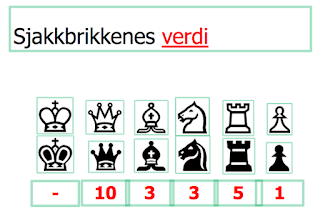
Piece values / strength:

The “language” of the chess pieces
Each square has its own name, with files running vertically and ranks horizontally:
The names of the squares in algebraic notation
Abbreviated piece notation:
Each officer piece, meaning all chess pieces except pawns, is indicated by the first letter of its name, written in uppercase. Examples: K = King, Q = Queen, R = Rook, B = Bishop, N = Knight. (For convenience, the letter N is used for the knight.) As the first letter of the piece names may vary between languages, players are free to use the convention common in their own country. In printed material, the use of figurine symbols for the pieces is recommended.
Pawns do not use a letter in their notation. Pawn moves are therefore recognized by the absence of such a letter.
The goal of the game is to trap the king (checkmate) and deliver the decisive blow (check) in the end.
Here is checkmate in two moves:
The special rules are:
1. Castling
2. En passant
3. Pawn promotion
4. Draw
Especially the last one, the draw, is somewhat extensive and includes:
A. Perpetual check
B. Stalemate
C. Insufficient material to deliver checkmate
D. The same position occurring three times
There are many other rules related to club and tournament chess. We will return to those later.
2. Getting started – opening strategyIt is recommended to begin with one of the central pawns, for example e4. This way you try to gain some control of the center of the board (the battlefield). Then you should develop a knight or bishop on the kingside – this increases central control and prepares space for the king and rook to change places (the move called castling). In this way the king is brought into safety (a small fortress on the side), while the rook becomes active toward the center and participates in the struggle for central control.
The three basic opening principles are:
- Control of the center
- Development of minor pieces (do not leave them sleeping on the first rank)
- Bring the king to safety quickly by castling

White has just placed the king safely without interfering with the fight in the center of the board. Both White and Black are trying to gain control of the center. The moves are listed below (all squares have names/coordinates. The pieces are identified by a letter before the coordinate (N = Knight, B = Bishop, R = Rook, 0-0 = Castling). Pawns are written without a letter:
1.e4 e5
2.Nf3 Nc6
3.Bc4 Nf6
4.d3 h6
5.O-O

White does not advance the central pawns as recommended to gain control of the center, but instead pushes pawns on the kingside. This leads to a weakened kingside, and White loses after only two moves. (This position is known as Fool’s Mate and is not included among standard openings.)
1.g4 e5
2.f3 Qh4 (and Black delivers checkmate)
Link to popular openings from Chess.com: https://www.chess.com/no/article/view/de-beste-sjakkapningene-for-nybegynnere
3. How to deliver checkmate
Scholar’s Mate is perhaps the “trap” that decides the greatest number of games.
1.e4 e5 2.Qh5 It is generally not good to bring the queen out so early, but Black must be careful. 2...Nc6 3.Bc4 with a serious threat. Now Black should play 3...g6 or 3...Qe7, but not 3...Nf6?? 4.Qxf7# 1–0
The f2-square for White and the f7-square for Black are considered among the weakest squares on the board. They are only defended by the king and are often attacked by the opponent. In this case, Black is checkmated on f7 by White’s queen. In other situations, a knight may land on f7, simultaneously attacking the queen and a rook – a critical threat. .
.
Rook Ladder Mate
How does White deliver checkmate in just a few moves here?
 Many beginners move the rook from a5 to a6, checking the black king.
However, the correct solution is first to keep the rook on a5, preventing the king from escaping further onto the board or hiding behind its pawns.
White should therefore move the other rook to b6, forcing the black king further down toward the last rank. Then White continues with the rook from a5 to a7, giving another check, and finally the other rook goes to b8, delivering checkmate.
The white rooks thus move alternately one step further down, like feet stepping down a staircase – hence the name “ladder mate”. Similar situations often arise in endgames where rooks can deliver checkmate in this way.
Attack on the 7th and 8th rank
 Even here, a beginner often has trouble delivering checkmate with the white pieces. He is tempted to give check with one of the rooks, allowing the king to wander further onto the board and wasting time. In practical play, a chess clock is usually used to ensure fairness, or alternatively a chess clock app on a mobile phone.
SOLUTION:
One rook moves to the second-to-last rank without giving check. Then the other rook moves down to the last rank and delivers checkmate on the next move.
To evaluate which piece you should capture when you risk allowing your opponent to recapture one of your own pieces, it is important to know the relative value of each piece. If you exchange equal pieces, the trade is often neutral, but sometimes you must also consider whether your piece is better or worse placed than your opponent’s.
For example, if you capture three of your opponent’s pawns but lose a knight or bishop in return, the exchange is often roughly equal. However, especially if those pawns are dangerously close to the first rank and can be promoted to a queen, it may be “good business” to capture them even if you lose a minor piece in return.
Fork
 Here Black has just moved the knight to the edge of the board (which was a poor decision). White, on the other hand, has the king safely defended and a knight in a strong central position. White exploits this immediately by launching a deadly attack, threatening two pieces at once (the king and a rook). Black must move the king out of check, and White can then capture the rook. White gains a decisive material advantage and wins relatively easily.
The idea of attacking two pieces at the same time is something you should always be alert to — and equally aware that your opponent may try to do the same to you.
Pawn fork
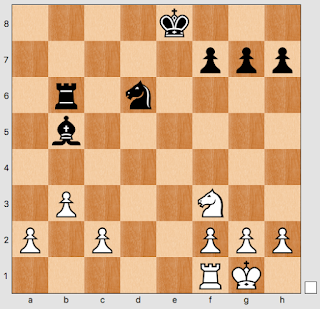 Here White achieves a pawn fork by thinking two moves ahead. Attacking two of the opponent’s pieces at the same time (a fork) can sometimes also be achieved with the queen or the king. Can you see the solution here?
SOLUTION
White first plays c4, and the black bishop retreats to avoid being captured. The same pawn then advances one more square to c5, creating a fork. White will then win either the black rook or the knight.
Skewer
 Black has just advanced the king after a roughly equal position. This king move was very poor — how can White punish it?
SOLUTION:
Qb3! is an excellent move here, checking the black king and forcing it away from the diagonal. White can then capture Black’s queen with his own queen and win easily.
Pin
 Black was clearly better here and should have won, but played Ra5–d5?? (a very poor move). How do you think White wins now?
SOLUTION:
The bishop moves to b3, pinning the rook along the diagonal to the king. This is an absolute pin, since the rook is not allowed to move because that would expose the king to check. (If there had been a queen on g8 instead of the king, it would have been a relative pin.) White wins the rook for free and easily wins the game.
How does White deliver checkmate in just a few moves here?

However, the correct solution is first to keep the rook on a5, preventing the king from escaping further onto the board or hiding behind its pawns.
White should therefore move the other rook to b6, forcing the black king further down toward the last rank. Then White continues with the rook from a5 to a7, giving another check, and finally the other rook goes to b8, delivering checkmate.
The white rooks thus move alternately one step further down, like feet stepping down a staircase – hence the name “ladder mate”. Similar situations often arise in endgames where rooks can deliver checkmate in this way.
Attack on the 7th and 8th rank

SOLUTION:
One rook moves to the second-to-last rank without giving check. Then the other rook moves down to the last rank and delivers checkmate on the next move.
4. Tactical tips and tricks in the middlegame . . .
For example, if you capture three of your opponent’s pawns but lose a knight or bishop in return, the exchange is often roughly equal. However, especially if those pawns are dangerously close to the first rank and can be promoted to a queen, it may be “good business” to capture them even if you lose a minor piece in return.
Fork

The idea of attacking two pieces at the same time is something you should always be alert to — and equally aware that your opponent may try to do the same to you.
Pawn fork

SOLUTION
White first plays c4, and the black bishop retreats to avoid being captured. The same pawn then advances one more square to c5, creating a fork. White will then win either the black rook or the knight.
Skewer

SOLUTION:
Qb3! is an excellent move here, checking the black king and forcing it away from the diagonal. White can then capture Black’s queen with his own queen and win easily.
Pin

SOLUTION:
The bishop moves to b3, pinning the rook along the diagonal to the king. This is an absolute pin, since the rook is not allowed to move because that would expose the king to check. (If there had been a queen on g8 instead of the king, it would have been a relative pin.) White wins the rook for free and easily wins the game.

Kommentarer
Legg inn en kommentar